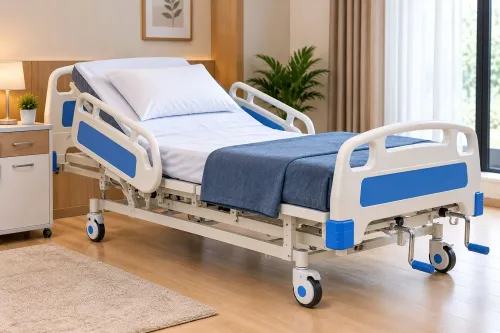

A semi-Fowler cot can suit several hospital departments, but “Deluxe” does not define its clinical capability or safety performance. By checking the intended patient group, adjustment functions, load ratings, mattress fit, mobility, cleanability, documentation, and service support, a Chennai procurement team can decide whether the offered bed belongs in the tender and where it can be used.
Key takeaways
- Use semi-Fowler cots for stable patients needing basic backrest positioning.
- Approve manual adjustment when staff can reposition patients safely and promptly.
- Specify backrest range, safe working load, dimensions, castors, brakes, and warranty.
- Check cleaning access, welds, mattress fit, documentation, and service support before purchase.
Which hospital departments can approve a semi-Fowler cot?
Yes. Chennai procurement teams can use semi-Fowler cot deluxe for hospital beds in Chennai’s general wards, observation areas, and step-down units when patients are stable, staff need basic backrest positioning, and the technical submission confirms the bed’s limits.
| Department | Patient dependency | Positioning frequency | Transfer needs | Required accessories |
|---|---|---|---|---|
| General inpatient ward | Stable, low to moderate | Occasional manual adjustment | Bedside transfers; not occupied transport | Brakes, side rails, IV-pole sockets if required |
| Outpatient observation | Stable and short-stay | Occasional | Transfers to wheelchair or trolley | Brakes, cleanable mattress, rails |
| Emergency holding | Stable while awaiting care | Occasional | Frequent movement between areas | Locking castors, bumpers, oxygen provision if specified |
| Recovery room | Stable after procedure | Repeated observation adjustments | Assisted transfer | Rails, IV pole, monitoring access |
| Step-down care | Moderate dependency | Regular; escalate if frequent | Assisted transfer | Rails, IV pole, oxygen provision |
| Long-term or home care | Stable and caregiver-supported | Occasional | Room-to-room transfer | Brakes, suitable rails, mattress system |
| Examination area | Brief-use patient | As needed | Transfer to examination surface | Brakes and wipe-clean surfaces |
Do not approve this model for intensive care, ventilation, highly dependent patients, bariatric loads, or frequent repositioning without escalating to an electric or ICU specification. “Deluxe” is marketing language, not a performance category.
Confirm whether it repositions only an empty frame or is rated for occupied-bed transport; a crank-operated bed is not automatically a patient transporter. Compare each offer in an approved-use matrix for hospital beds for procurement teams, including dependency, positioning, transfer needs, and accessories.
When is manual adjustment clinically adequate?
Manual adjustment is clinically adequate when the patient is stable, staff reposition them occasionally at the bedside, and the care plan does not require rapid repeated movement.
A crank-operated semi-Fowler cot for hospitals also remains usable during a power outage, but nursing time, physical effort, access around adjacent beds, and crank pinch or trip points still determine whether it fits.
| Option | What it provides | When it applies |
|---|---|---|
| Fixed-height frame | No positioning movement | Stable patients who need a firm sleeping surface and repositioning by staff |
| Manual backrest-only bed | Head and trunk elevation | General wards, examination areas, and observation when knee elevation is unnecessary |
| Separate backrest-and-knee bed | Independent trunk and leg positioning | Patients needing comfort, edema management, or assisted repositioning without powered movement |
Require the supplier to state:
- Backrest angle or full adjustment range
- Crank location, number of cranks, and access from either side
- Approximate crank effort
- Whether the backrest holds its position under load
Do not treat “semi-Fowler” or “Deluxe” as proof of knee-break, height adjustment, Trendelenburg, reverse Trendelenburg, IV-pole sockets, oxygen-bottle provision, or urine-bag hooks. Each is a separate specification.
Choose an electric, ICU, motorised, or multi-function bed when staff need repeated powered movement, rapid Trendelenburg or reverse Trendelenburg, ventilator access, integrated monitoring equipment, height adjustment for safe transfers, or frequent repositioning of a highly dependent patient. Manual hospital bed applications fail when every adjustment consumes staff time or exposes caregivers to unsafe exertion.
Which technical figures must appear in the tender?
A tender can compare a semi-Fowler cot only when the supplier gives measurable limits, not “Deluxe” as a performance claim. Specify these figures for hospital beds for procurement teams:
- Safe working load and maximum patient weight, stated separately.
- Overall length, width, and height; mattress-platform length and width; under-frame clearance; permitted mattress thickness.
- Backrest angle or adjustment range, stability with the backrest raised under the stated load, and the number and position of adjustment cranks.
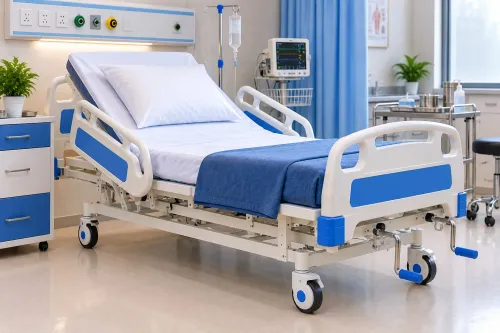
- Castor diameter, wheel type, individual castor brakes or central braking, wheel-leg construction, and whether movement with an occupied bed is permitted or the frame is for empty-bed repositioning only.
| Tender item | Supplier must state | Reject or clarify when |
|---|---|---|
| Platform and mattress | Exact mattress length, width, thickness, density, patient-weight rating, waterproof cover, cleaning method, and fire performance | Dimensions or thickness are described only as “standard” |
| Side rails | Usable length, height above the specified mattress, locking method, unintended-release protection, and compatibility with the frame and mattress | “Collapsible rails” is the only safety information |
| Mobility | Brake arrangement and occupied-bed transport limit | The offer does not distinguish transport from repositioning |
A thicker replacement mattress reduces the rail’s effective height above the patient surface and changes gaps around the rail, increasing entrapment risk. Require the tested mattress specification, not a later substitute. Rails alone do not establish fall-protection compliance for every patient category; patient dependency and supervision remain part of approval.
How should Chennai teams verify safety, hygiene, and compliance?
Hospital bed procurement in Chennai should require evidence, not an “IEC certified” statement. Request the exact edition of IEC 60601-2-52, the conformity evidence scope, supporting test reports, instructions for use, labeling, and the product’s regulatory status under India’s Medical Devices Rules and applicable CDSCO requirements. Confirm that the documents cover the offered bed and accessories.
At incoming inspection, record whether:
- Edges are smooth, coatings are intact, hollow sections are sealed, and welds are even.
- Joints and crank mechanisms are reachable for cleaning, without finger-trapping or pinch points.
- Castors move correctly, each brake holds, and the frame remains stable.
- Side rails release only through their intended action and lock without unintended release.
- Mattress supports, IV-pole sockets, and bumpers are secure and free from sharp projections.
- Every crank completes its travel and the backrest holds its position without drift.
Chennai’s humid coastal air makes material identification essential for hospital beds for procurement teams. Require the supplier to identify painted, plated, and stainless-steel components, describe each coating system, and show coating continuity across welds and edges; “powder-coated MS” alone proves little.
Select smooth, sealed, wipe-clean surfaces with no fluid-trapping recesses and cleaning access around castors, joints, and the mattress platform. Check the rail, mattress, and frame as one system: a thicker or incompatible mattress can reduce usable rail height and create entrapment risk even when each component passes inspection alone.
How can a procurement team protect the total cost of ownership?
A defensible hospital bed procurement in Chennai prices downtime, not just the invoice. Require a warranty duration, service response time within Chennai, preventive-maintenance instructions, and training for nursing and biomedical staff. Ask for a written spare-parts plan covering cranks, castors, brake components, fasteners, mattress supports, and side-rail parts.
1. Define the tender limits: clinical use, patient-weight limit, safe working load, bed and mattress-platform dimensions, clearances, permitted mattress thickness, brake arrangement, and every supplied accessory.
2. Require each bidder to state replacement-part availability, service contacts, repair escalation, inspection intervals, cleaning instructions, and the cost and lead time for parts. This exposes a cheap bed that becomes unusable after one failed crank or castor.
3. Witness a technical demonstration with a representative load. Operate every crank through its full travel, confirm that the backrest holds without drifting, test each brake, measure dimensions and clearances, verify safe working load, and inspect rails, IV-pole sockets, bumpers, mattress supports, and other accessories.
4. Compare hospital beds for procurement teams on documented specifications, conformity evidence, replacement-part access, and demonstrated service capability. Evaluate Optimal Aid India, or any Chennai manufacturer or supplier, by those records rather than catalogue language.
Can procurement teams use Semi Fowler Cot Deluxe for hospital beds in Chennai? Approve it only when its clinical application, measurable limits, safety evidence, environmental durability, mattress system, and after-sales plan are recorded and demonstrated. That rule protects total cost of ownership.
Related products
 | Hospital Furniture Semi Fowler Deluxe (Manual) Bed – User Manual In Chennai 🔧 1. View product → |
 | Cot Series Semi Flowler Cot Deluxe Wheel Leg Manual Semi Flowler Cot Deluxe Wheel Leg Manual In Chennai. We wre one of the Leading and best quality manufacturer of Hospital Furniture In chennai and we... View product → |
Frequently asked questions
Which hospital departments can approve a semi-Fowler cot?
General wards, observation areas, and step-down units can approve a semi-Fowler cot when patients are stable and only basic backrest positioning is required. Include nursing, biomedical, infection-control, and procurement review before purchase.
When is manual adjustment clinically adequate?
Manual adjustment is adequate when staff can reposition stable patients safely and promptly, and the care plan does not require frequent independent or electrically controlled positioning. It is unsuitable when rapid, precise, or repeated repositioning is essential.
Which technical figures must appear in the tender?
State the backrest adjustment range, overall and mattress-platform dimensions, safe working load, patient weight limit, mattress thickness, castor diameter, brake configuration, frame material, warranty, and delivery requirements.
How should Chennai teams verify safety, hygiene, and compliance?
Inspect the frame, welds, joints, side supports, castors, brakes, and mattress fit. Request the user manual, warranty, test reports, material details, cleaning instructions, and supplier service records, then document acceptance checks.
How can a procurement team protect the total cost of ownership?
Compare purchase price with delivery, installation, spare parts, mattress replacement, cleaning time, warranty coverage, staff training, and service response. Require clear exclusions, parts pricing, preventive-maintenance terms, and a defined warranty period.
Keywords