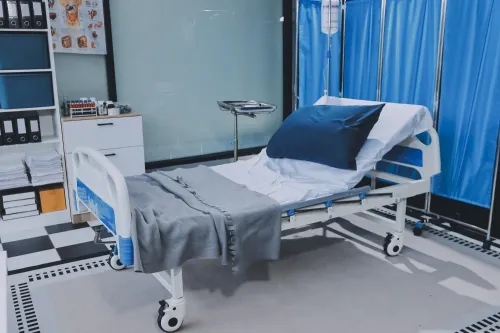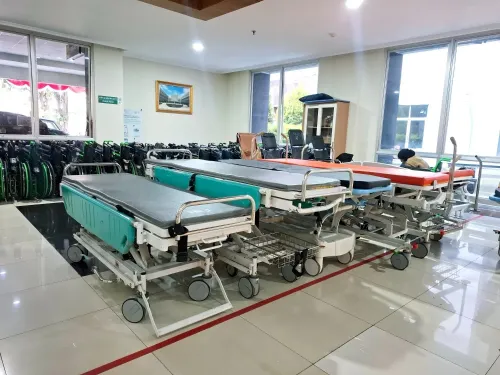

A Semi-Fowler bed is useful when a patient must move repeatedly between lying, supported sitting, examination, treatment, and short recovery. The right choice depends on room layout, adjustment workload, patient safety, measurable specifications, and whether the clinic needs a bed at all; by the end, you can compare configurations and write a practical purchase checklist.
Key takeaways
- Match bed features to procedures, observation time, and available room space.
- Keep fingers clear of moving parts while turning the manual crank.
- Specify castor locks, clearances, mattress details, and cleaning compatibility.
- Test bed movement, parking, access, and disinfection before purchase.
Match the bed to the clinic task and room
A Semi-Fowler bed earns room space when a patient needs supported back elevation, repositioning, or observation beyond a brief examination. It suits injections, dressing changes, post-procedure recovery, and short-stay monitoring; a semifowler deluxe manual for medical furniture clinics in chennai should not be treated as a universal examination surface.
| Room | Clinic activity | Best-fit surface |
|---|---|---|
| Treatment room | Injections, wound dressing, catheter care, and assisted repositioning | Semi-Fowler bed, especially when the patient may remain supine or semi-upright |
| Observation or recovery bay | Monitoring after sedation, minor procedures, or treatment | Semi-Fowler bed with a specified mattress platform and safe working load |
| Procedure room | Minor procedures needing back support and access around the patient | Semi-Fowler bed when its width and accessories leave working clearance; otherwise use a procedure table |
| Consultation room | History-taking, routine physical examination, and brief assessment | Examination couch, because a bed consumes space and adds adjustment and cleaning work |
| Short-stay room | Several hours of observation, fluids, or recovery | Semi-Fowler bed; confirm that castors can park securely on the actual floor |
Choose another surface when the patient only needs to sit or lie briefly, the clinician needs a firm flat platform, or sterile instruments require a dedicated procedure trolley. An examination couch is usually easier to clean and manoeuvre in a compact consultation room, while a fixed cot suits simple overnight holding without repeated back adjustment.
Specify these boundaries when comparing medical furniture for clinics in chennai.
Operate the manual crank without creating a new hazard
Raise the backrest from the bed’s side, not from the foot end or over the patient. A semifowler manual bed for clinic use needs clear space around the crank, ratchet, and linkage before adjustment; loose clothing, fingers, oxygen tubing, and monitor leads can enter the mechanism and become trapped.
- Park the bed on a level surface and engage the castor brakes. Check that the crank handle can turn without striking a wall, trolley, curtain, or connected equipment.
- Tell the patient what will move, support their head and shoulders, and confirm that their hands are away from the side hinges and mattress-platform gap.
- Check oxygen tubing, intravenous lines, drains, cables, and catheter bags for slack. Move each line clear of the backrest frame before turning the crank.
- Turn the crank slowly while watching the patient and the line paths. Stop if the patient slides, reports pain, or a tube becomes taut.
- Stop at the required angle and reverse the handle slightly if the mechanism requires it to engage. Push the backrest gently to confirm it is locked before the patient leans against it.
- Lower it gradually while supporting the patient and checking the same pinch points. Fold or secure the crank afterward so it cannot catch clothing or equipment.
Never force a stiff crank or reach through moving linkages. Remove the patient from the adjustment area and report the fault for maintenance; forcing it can release the backrest unexpectedly.
Compare bed types and define what “Deluxe” must include
Choose the surface by the patient’s position and duration: an examination couch suits brief consultations, a fixed cot suits lying-down care without repositioning, a Semi-Fowler bed suits observation and recovery, and a Fowler or three-function bed suits patients needing repeated back, knee, and height changes.
| Option | What it provides | When it applies |
|---|---|---|
| Examination couch | A fixed, accessible surface for examination | Consultations, injections, and short procedures |
| Fixed cot | A stable horizontal platform with no positioning mechanism | Basic resting or overnight care without posture changes |
| Semi-Fowler bed | A manual backrest, often with separate knee or leg-rest adjustment | Observation, dressing changes, recovery, and short stays |
| Fowler or three-function bed | Backrest, knee section, and height adjustment; some models add Trendelenburg | Frequent transfers, complex nursing, or treatment requiring working-height changes |
“Deluxe” is a sales label, not a specification. For a semifowler deluxe manual, require a drawing and data sheet stating the backrest angle or adjustment range, knee-break function, overall length, width and height, mattress-platform length and width, castor size, and included rails, IV pole, mattress, and bumpers.
- Confirm the safe working load includes the patient, mattress, bedding, accessories, attached equipment, and movement during repositioning; request the test conditions.
- Ask whether the crank, ratchet, or gas-assisted mechanism meets the supplier’s stated assessment against ISO 60601-2-52.
- Obtain prices and response times for crank handles, castors, latches, mattress covers, and backrest parts.
Check circulation, castors, parking, and Chennai cleaning conditions
Measure the route, not just the treatment room. Record the bed’s overall length and width, each doorway’s clear opening, lift-car dimensions, corridor width, turning radius, threshold height, ramp width and slope, and the parked position’s cleaning clearance.
A Semi-Fowler manual bed for clinic use is transferable only if its castors and attached equipment fit the narrowest point. Include an oxygen cylinder, IV stand, mattress and side rails in the trial; a bare frame can pass where the working bed cannot.
Use this acceptance checklist:
- Push the bed over every threshold and ramp with trained staff, then check for castor lift, frame contact, uncontrolled rolling and excessive handle force.
- Confirm every castor swivels, the brakes hold on the clinic’s steepest floor and ramp, and the parking position leaves access to both sides, the head end and the crank.
- Turn the bed through the tightest corner without striking walls, doors, sinks or equipment. Test the route with the backrest raised if that is how staff move it.
- Mop and disinfect the route and parking area, then check whether water or disinfectant collects around castor mounts, welds, joints and under the frame.
- For medical furniture for clinics in Chennai, ask for the permitted cleaning chemicals, protection for cut edges and welds, corrosion-resistant fasteners, and a procedure for chipped epoxy coating or rust.
Obtain prices and availability for caster sets, crank handles, mattress covers and backrest parts. Also request the preventive-maintenance schedule and breakdown response time before approving the purchase.
Turn the purchase into a testable clinic specification
Specify the bed by measurable performance, not the label “deluxe.” For a Semifowler Deluxe Manual for medical furniture clinics in Chennai, record backrest angle or range, sections, height, platform and overall dimensions, safe working load, castor diameter, brakes, rails, accessories, and mattress specification.
| Option | Adjustment | Best fit |
|---|---|---|
| Manual | Lowest complexity; no electricity; slower and requires staff effort | Low-volume clinics and short-stay observation |
| Hydraulic | Foot-pedal height or position adjustment; added pump maintenance | Frequent transfers or height-sensitive procedures |
| Electric | Fast, quiet positioning; needs power, controls, and electrical maintenance | High-use recovery or procedure areas |
Require a mattress that matches the platform without gaps, folds at the backrest joint, has a waterproof welded-seam cover, resists disinfectants used by your clinic, and states its safe load. Specify pinch-point protection, functioning side-rail latches, secure head and foot boards, stable brakes, and an accessible emergency release where the design includes one.
ISO 60601-2-52 is the named medical-bed safety benchmark to discuss with the clinic medical furniture manufacturer; request its test or assessment evidence, not a catalogue claim.
- Obtain prices and availability for caster sets, crank handles, backrest parts, rail latches, covers, and recoating; require a preventive-maintenance schedule and breakdown response time.
- Ask Optimal Aid India to place every agreed measurement and accessory on the quotation.
- On delivery, match the serial number and dimensions to the order, inspect welds and coating, test every adjustment, brake, rail, wheel, and mattress fit with a patient-free load, then record defects before acceptance.
Related products
 | Hospital Furniture Semi Fowler Deluxe (Manual) Bed – User Manual In Chennai 🔧 1. View product → |
 | Cot Series Semi Flowler Cot Deluxe Wheel Leg Manual Semi Flowler Cot Deluxe Wheel Leg Manual In Chennai. We wre one of the Leading and best quality manufacturer of Hospital Furniture In chennai and we... View product → |
Frequently asked questions
Which clinic tasks suit a semifowler manual bed?
Use it for injections, dressing changes, post-procedure recovery, and short-stay monitoring when supported back elevation or repositioning is needed. It is not a universal examination surface.
How can staff operate the manual crank safely?
Check that the patient and equipment are clear, keep hands away from moving joints, turn the crank smoothly, and confirm the backrest is stable before care begins.
What should “Deluxe” include in a semifowler manual bed?
Define the term in writing. Specify backrest adjustment, frame and mattress dimensions, side rails if required, castors, brakes, load capacity, mattress construction, finish, warranty, and service support.
What should Chennai clinics check before installing the bed?
Measure doorways and working clearances, confirm castors park securely, and check that surfaces and mattress covers tolerate the clinic’s cleaning products and humid conditions.
Related product
 | Hospital Furniture Semi-Fowler Mattress It’s a 2-section (or foldable) medical mattress used on Semi-Fowler beds. View product → |
Keywords